German researchers develop quick and easy way to measure power consumption
The new ‘energy analyzer’ was developed in collaboration with Rauschert GmbH – a manufacturer of advanced ceramic products that require energy-intensive production processes. The research project was funded by the Bavarian Ministry of Economic Affairs, Infrastructure, Transport and Technology as part of its microsystems technology program.
Until recently, large-scale industrial energy users in Germany have benefited from reduced tax rates on the electricity and gas they consume. Now the German government has decided that companies will only be eligible for such tax breaks if they take steps to reduce their energy consumption. From 2013 onward, tax rebates will only be granted to companies equipped with an energy management system that provides details of their power consumption. This won’t be an easy task for the companies concerned, because it means they will have to install individual auxiliary meters to monitor the power consumption of individual loads such as presses and welding machines, or bakers’ ovens, or electric motors. And in many cases the metering instruments currently available on the market are too large to fit into existing power distribution cabinets.
The new device is based on the HallinOne 3-D magnetic field sensor originally developed by IIS for use in Bosch and Siemens branded washing machines, where it monitors the position and orientation of the rotating drum.
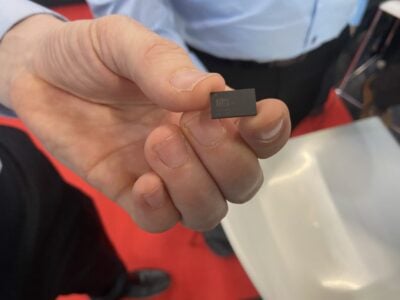
“This new device is the first application in which we have used our 3-D magnetic-field sensor technology to measure the magnetic field generated by an electric current as a means of determining the energy consumed by the connected load. As such, it is an entirely novel approach,” said IIS research scientist Michael Hackner. To build the device, he and his team of qualified engineers mounted eight sensors, in the form of application-specific integrated circuits (ASICs), on a flexible, flat circuit board. What sets these sensors apart from more conventional designs is that they measure the magnetic field not only perpendicular to the surface of the chip but also in tangential directions, which improves measurement accuracy. The recorded data are transmitted to a microcontroller, which forwards them to a central processor via a gateway switch. “
“Our power sensor is quick to install and can be integrated online,” said Hackner, citing one of the advantages of the new product.
Hackner goes on to emphasize another unique design feature, namely the fact that it functions in the same way as a Rogowski coil, a component incorporated in many standard instruments used to measure electrical currents.
“But the Rogowski coil only measures alternating current, whereas the IIS sensor can also measure direct current – an important consideration when measuring the power consumption of photovoltaic systems that include solar inverters for converting DC output into AC power.”
The metering device is cheap to build. And because the IIS researchers have not used any magetizable materials in its design, there are no accuracy errors from this source – a recurring problem with other clamp-on amp meters that cease to function correctly after a short-circuit. Another advantage is that, unlike clamp ammeters, the new device can also measure voltages. In short, users now have an all-in-one instrument capable of measuring all the parameters they need to monitor the quality of the grid supply in addition to the power consumption. Michael Müller, head of energy management systems at Rauschert GmbH, provides an example: “The new device helps us to rapidly identify production problems. We can immediately detect irregularities in the firing process and avoid having to scrap a whole batch of ceramics.” He intends to set up an energy-management consulting service for other plants in the group and equip them with the new measurement system.
The sensor devices can even be installed in the power utility’s medium-voltage network (20 kV). As a result of the German Renewable Energy Sources Act (EEG), there are now a large number of small and medium-sized electricity producers feeding energy into the grid, without being obliged (or able) to inform the energy provider exactly how much power is flowing on a specific line at any given time, and in what direction.
“The grid capacity could be utilized much more efficiently if detailed measurement data were available,” affirmed Hacker and Müller in unison. The two experts reckon there is huge market potential for this application: In Bavaria alone, the 20-kV distribution network contains tens of thousands of transformer stations, which could be equipped with the new, low-cost device without having to temporarily disconnect the stations or the transmission lines from the grid. A prototype measuring system for low-voltage networks has already been developed.
IIS researchers will be presenting live demonstrations of the device at the Sensor+Test 2012 trade fair in Nuremberg from May 22 to 24 (Hall 12, Booth 202). The working prototype was built by Loewe Opta GmbH, who will also be manufacturing the final system.
More information about the metering unit at
www.fraunhofer.de/en/press/research-news/2012/may/the-quick-and-easy-way-to-measure-power-consumption.html
 If you enjoyed this article, you will like the following ones: don't miss them by subscribing to :